
Circumcision Aftercare
Complete Circumcision Aftercare Guide: What Parents Need to Know After a Bris or Newborn Circumcision
By Rabbi Shlomo Golish, C.M.


A family moment with parents holding their newborn after post-circumcisionin a relaxed home setting.
Circumcision aftercare can feel overwhelming for new parents, especially in the first 24 hours.
Every mohel has a slightly different technique, and babies heal at different speeds. This guide explains, in clear and simple terms, how to care for your baby whether your mohel leaves a bandage, a light dressing, or no bandage at all.
It also covers topics such as gauze changes, baby oil vs. Vaseline, diapering strategies, bathing instructions, bleeding concerns, and long-term cosmetic care — all organized for easy reference.
This article is optimized for parents searching for bris or circumcision aftercare, newborn circumcision care, post-circumcision bandage instructions, and circumcision healing timeline.
SECTION 1: The first 24 hours:
If the Mohel Leaves a Bandage On
Some mohelim apply a snug bandage around the base of the penis, covering everything except the glans, which should usually remain visible. This bandage is normally left on for about 24 hours — not longer.
Do Not Touch the Actual Bandage
Parents should not touch, adjust, unwrap, or tighten the bandage in any way.
Your only responsibility is the outer gauze pad overlay, not the core bandage itself.
Changing the Outer Gauze Pad
Your mohel will tell you how often to change the gauze — usually every couple of hours.
Guidelines:
-
It is okay for urine to get onto the gauze pad.
-
If stool gets on it, the gauze must be changed immediately.
-
The replacement gauze may be prepared in one of the following ways:
-
Pour baby oil over it until fully saturated, or
-
Place the gauze pad in a dish with baby oil and let it soak, or
-
Smear a generous amount of Vaseline (or A&D ointment) over it before applying.
-
The purpose is always the same: prevent sticking and provide a protective moisture barrier.
How to Close the Diaper Properly
When the baby wears a bandage:
-
Do not close the diaper tightly against the penis.
-
Use your fingers to create a little breathing room in front.
-
Close the diaper snugly against the belly, not against the circumcision.
This reduces friction and avoids unnecessary pressure on the healing tissue.
Bathing During the First 24 Hours
No baths should be given on Day 1 — regardless of whether there is a bandage or not.
Why:
-
You don’t want prolonged soaking when hemostasis is still stabilizing.
-
Babies kick and move in water, which can disrupt the area.
-
Keeping things appropriately moist and appropriately dry (not submerged) is key.
If the Mohel Leaves a Light, Easy-to-Remove Bandage
Some mohelim leave a very light wrap that the parents themselves remove after 24 hours.
This dressing is designed to come off easily.
How Removal Works
-
After 24 hours, place the baby in a warm bath.
-
Slow soaking helps loosen the bandage.
-
Find the end of the wrapping and unwind it gently, either clockwise or counterclockwise — your mohel will tell you which direction.
-
It should slide off smoothly without force.
Once removed, the baby transitions into standard ointment-and-gauze aftercare, just like any baby starting Day 2.
If the Mohel Leaves No Bandage at All
In a “no-bandage” technique, parents are responsible for creating the protective barrier layer.
How to Apply the Protective Gauze
Take a 3x3 gauze pad and load it heavily with Vaseline or A&D ointment.
Really saturate it.
Then:
-
Place it over the entire penis like a little hat, coating everything.
-
This protects the wound from friction and sticking.
Increased Risk of Bleeding
Without a bandage, minor bleeding is more common, which is expected because:
-
There is no compression on the wound.
-
There is more freedom of movement.
Parents should know what to do in case of emergency bleeding:
If bleeding occurs: what to do
-
Take a fresh gauze pad.
-
Apply firm, steady pressure from all sides of the penis.
-
Maintain pressure for 10–15 uninterrupted minutes.
-
Simultaneously attempt to contact the mohel.
-
If the mohel cannot be reached promptly, contact a medical professional.
Do not keep peeking during the 10–15 minutes — pressure must be continuous.
Behavior, Comfort, and Monitoring the Baby
-
Babies often sleep more after a bris — this is normal.
-
Wake the baby for feedings to avoid dehydration.
-
If the baby cries intensely and remains inconsolable, especially with a bandage on:
-
Contact the mohel immediately to ensure the bandage is not causing discomfort.
-
Urination Patterns
-
Many babies pee less frequently for the first day.
-
Sometimes they urinate in amounts too small to trigger the diaper’s indicator strip.
-
If the baby is comfortable and not crying excessively, this is usually fine.
-
If he is crying and not urinating, call the mohel.
-
Holding the baby flat on Day 1 is recommended, as it reduces blood rushing toward the area.
Normal diaper observations
-
Red staining on Day 1 is common.
-
Light staining on Day 2 or even Day 3 can still be normal.
-
A diaper may occasionally stick if the ointment layer dried — this can cause a small “pull-bleed.”
-
If you ever see active dripping blood, contact your mohel immediately.
Double-Diapering and Padding
Some mohelim recommend extra padding on Day 1:
-
Two diapers
or -
Diaper → pants → another diaper over the pants
This adds cushioning and reduces friction.
Infant Tylenol (infant acetaminophen) can be used if recommended by your pediatrician.
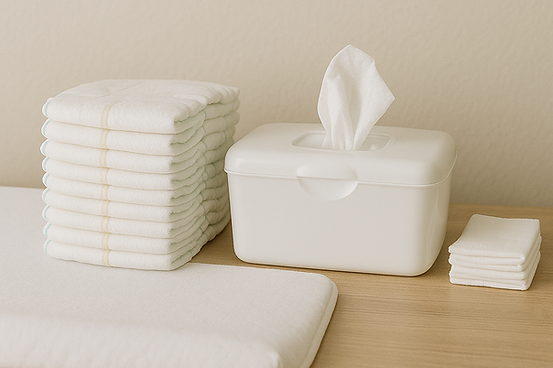
Diapers and wipes prepared on a clean changing table — ready for newborn care and frequent changes post circumcision.
SECTION 2: Aftercare Starting Day 2 (or immediately after bandage removal)
Once the 24-hour bandage is removed — or if there was no bandage to begin with — all babies follow the same aftercare routine.
Daily Warm Bath
A daily warm bath is extremely helpful for healing.
How to bathe safely:
-
Wait until at least 24 hours after the bris.
-
Submerge the penis only, keeping the baby’s umbilical cord out of the water if it hasn’t fallen off yet.
-
After soaking a few minutes:
-
Take a gauze pad.
-
Dip it in warm water with baby soap.
-
Wrap it gently around the penis.
-
Give a few light squeezes.
-
Do not rub.
-
A clean wound heals faster and better.
Positioning the Penis for Best Cosmetic Outcome
Beginning Day 2:
-
Gently position the penis downward, toward the feet, when closing the diaper.
-
This promotes the most aesthetic long-term alignment.
If the penis is very small or buried:
-
It may not stay downward — that’s fine.
-
Just encourage it gently, but never force it.
SECTION 3: Ongoing Diapering & Ointment Care
Change the gauze every couple of hours
Each time, replace with:
-
Vaseline-loaded gauze,
-
Baby-oil-soaked gauze, or
-
A&D-coated gauze,
depending on what your mohel instructed.
Continue this until the wound is fully healed, usually:
-
Major healing in 2–3 days
-
Full cosmetic healing in 1–2 weeks
SECTION 4: Expected Healing Appearance
Yellow Tissue Layer
A thick yellow layer (granulation tissue) that forms on the glans is:
-
Normal
-
Healthy
-
Part of healing
Do not attempt to remove it.
Timeline
-
Day 1: Red, moist, sensitive
-
Day 2–3: Yellow layer forms; swelling decreases
-
Day 4–7: Looks drier and more defined
-
Week 1–2: Almost fully healed
SECTION 5: Long-Term Cosmetic Care & Adhesion Prevention
As babies gain weight, pubic fat naturally pushes the penis inward, creating the appearance of a “hidden” or “buried” penis. In these cases, the skin of the shaft may begin to move up over the glans.
To prevent adhesions:
-
During bath time, gently “pop” the penis out so you can clean around it.
You can do this in two ways:
-
Make a V-shape with your fingers on both sides and push downward.
-
Create a circle with your thumbs and index fingers and gently press the skin down all around.
If you notice:
-
Skin sticking from the shaft onto the glans
-
Skin forming a smooth layer that looks continuous from shaft to glans
Contact your mohel.
He may guide you to gently separate it yourself, or he may prefer to handle it personally.
Final Thoughts
Circumcision aftercare does not need to be stressful. When parents understand the differences between bandage techniques, gauze use, ointment strategies, bathing routines, and what to watch for, the entire healing process becomes much smoother.
Most babies heal beautifully, quickly, and comfortably.
If you ever have a question, concern, or uncertainty — even something small — reaching out to your mohel is always the right move.
Local Bris & Circumcision Services in NJ, PA, and NY
If you live in New Jersey, Pennsylvania, or New York and are preparing for an upcoming bris or newborn circumcision, I am available to guide you through the entire process — from the pre-bris check to the final stages of healing. I regularly assist families throughout Central NJ, North Jersey, the Jersey Shore, the greater Philadelphia region, and New York City and its surrounding suburbs, including Lakewood, Toms River, Jackson, Howell, Monsey, Brooklyn, Queens, and Staten Island.
Parents reach out not only for the procedure itself, but also for clear, calm aftercare support — the same type of detailed, practical guidance you’ve read in this article. If you’re expecting and would like to discuss scheduling, preparation, or have questions about caring for your baby after the bris, you are always welcome to contact me.
It would be my honor to serve your family with professionalism, warmth, and expertise.

A parent changes a newborn’s diaper in a calm, organized space — part of a normal circumcision aftercare routine.


